Banana Monkey Destruction World Destruction System
How the destructible map layers gate progression, spawn banana income, and behave when up to eight monkeys share one city.
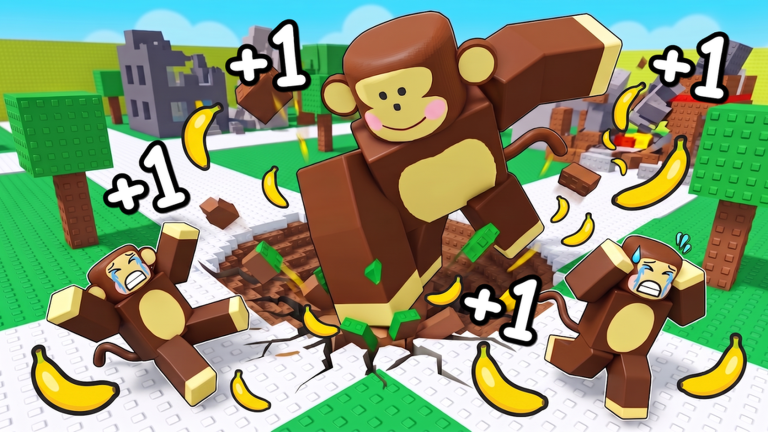
The title promises destruction, and Kaboom Creations delivers it as gated map progression. +1 Banana Monkey Destruction is not an open sandbox where every wall falls on day one. Objects carry health pools, zones expect minimum punch or size values, and advancing the wreckage frontier unlocks richer banana payouts. Understanding world systems prevents the frustrating pattern of strong currency with nowhere efficient to spend it.
Pair this page with Upgrades for stat definitions and Upgrade Priority for knowing whether punch or size fixes your current gate.
Map layers and progression front
Incremental maps typically organize as layers or districts—starter streets, denser city blocks, landmark structures, later spectacle zones. Each layer increases:
- Object health — requires higher punch tiers from Upgrades.
- Payout values — rewards match difficulty; see Bananas.
- Interaction requirements — some gates need minimum size or reach before punches register.
Your personal destruction front is the boundary where objects still break at your current stats. Behind you lies cleared space; ahead lies immune or inefficient targets.
Object health and punch thresholds
When time-to-break climbs above a few seconds on standard props, you hit a punch threshold wall—not a banana income wall. Symptoms include:
- Same routes yielding flat BPM in calculator tests despite multiplier upgrades.
- Visual cracks appearing slowly while lower zones respawn already cleared.
Fix: invest in punch power tiers until breakpoints return to one-to-three second range, per Early Game Tier List Phase 2 guidance.
Do not confuse threshold walls with depopulated zones from other players clearing objects—see multiplayer section below.
Size gates and reach checks
Some structures ignore undersized avatars entirely—punches connect visually yet deal zero damage or reduced damage. Kaboom Creations uses size as both fantasy fulfillment and mechanical gate.
Buy the minimum size tier that satisfies the interaction, then return to income stats unless the next zone explicitly demands more. Oversized monkeys without BPM look impressive in screenshots yet grind inefficiently.
Destruction radius and cluster routing
Dense city blocks reward destruction radius upgrades because one swing breaks multiple facades. Sparse zones reward movement between isolated targets instead.
Route planning steps:
- Identify cluster with steady respawns.
- Stand centrally to maximize radius overlap.
- Punch rhythmically without excessive repositioning.
- Log BPM for that route specifically.
Switch routes when a cluster empties faster than respawn timers—common on busy servers.
Multiplayer: eight-player shared world
Facts from live observation align with wiki release notes: up to eight players share a server instance. Progression currencies are account-bound, but destructible objects are shared.
Etiquette and efficiency tips:
- Rotate clusters when your primary strip is cleared—check side streets or secondary districts instead of idle punching empty rubble.
- Avoid griefing—destroying props other players actively farm is poor form even if mechanics allow it.
- Party advantage: Friends can intentionally split zones to reduce overlap, raising collective BPM without account sharing.
- Solo advantage: Private or low-population instances keep respawns predictable for benchmarking.
World design makes social play viable without requiring co-op mechanics—plan routes, not alliances.
Visual destruction vs mechanical progress
Cosmetic wreckage can outpace mechanical unlocks early. You may level a city block visually while the game still treats deeper districts as locked. Watch for:
- UI prompts pointing to new zones.
- Shop items referencing higher-tier currencies or stats.
- Trainer quests nudging map transitions.
If visuals say progress but BPM flatlines, you likely need punch thresholds or zone relocation—not more size.
World events and updates
Early-access maps receive health tweaks and spawn adjustments. After Updates Hub posts, revisit previously “finished” zones—developers sometimes buff payouts to pull players backward into older districts during events.
No verified codes exist as of August 2026 to skip world gates. Ignore social posts claiming instant map unlock strings.
Destruction pacing checklist
- Current cluster breaks in under three seconds per object
- BPM tested at cluster with trainer state noted
- Size meets known gate without excess tiers
- Secondary route identified for crowded servers
- Next zone entrance located and requirements understood
Related pages
- Bananas — rewards tied to object tiers
- Controls — punch consistently while routing
- Early Game Tier List — phase gates
- Systems Hub — full loop
Frequently Asked Questions
Quick answers to the most common questions.
Can other players steal my bananas?
Bananas credit to the account that earned the break under normal incremental rules. Shared worlds mean shared objects, not shared wallets.
Why does my map look destroyed but income is low?
You may be farming depleted or low-tier respawns. Push to the destruction front where health pools match your punch value.
Do private servers change world health?
Private instances mainly change player count and competition for objects, not typically solo health values—verify after major patches.
Is world destruction required for rebirth?
Rebirth rules are still stabilizing. Treat zone access as income optimization until Updates documents permanent reset bonuses.